
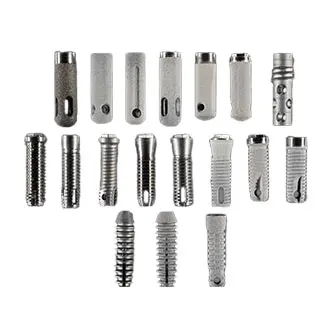
Historical implant forms
Implant dentistry has used hollow, blade-shaped and screw-shaped designs. Hollow and blade forms are now mainly of historical interest, while root-form screw implants are the predominant contemporary design.
Conical and cylindrical bodies can be combined with different thread geometries to address surgical handling and primary stability objectives.
Material categories
Implant materials have included metals, ceramics and composite concepts. Titanium and titanium alloys remain widely used because of their mechanical properties, corrosion resistance and established clinical history.
Material choice cannot be separated from manufacturing controls, surface condition and the evidence supporting the complete implant system.
Selection is case-specific
Implant diameter, length, body shape and connection should be selected from clinical and radiographic findings rather than brand or price alone.
Available bone, prosthetic space, anatomical limitations, loading strategy and the validated surgical protocol all influence the final choice.
This educational overview does not replace professional training, clinical judgment, current product labeling or instructions for use.