
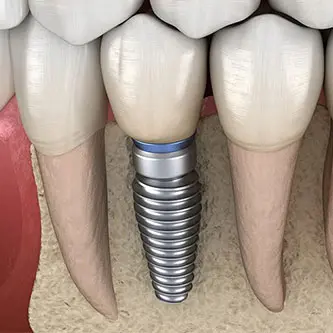
Periodontal ligament versus osseointegration
A natural tooth is suspended in its socket by the periodontal ligament. This tissue provides vascular, sensory and shock-absorbing functions between the root surface and alveolar bone.
An osseointegrated implant has no periodontal ligament. Bone contacts the implant surface directly, so force perception and load response differ from those of a natural tooth.
Mobility and load distribution
Natural teeth show greater physiological movement under vertical and lateral load. Implants move much less because of their direct bone anchorage.
As a result, occlusal contacts, prosthetic design and the distribution of forces deserve careful attention, particularly when implant restorations oppose or connect with natural teeth.
Anatomy and prosthetic position
The diameter and orientation of an implant do not reproduce every detail of a natural multi-rooted tooth. Available bone and nearby anatomical structures may limit the ideal position.
Restorative planning must bridge the difference between the implant position and the planned crown while maintaining cleanability and manageable loading.
Maintenance implications
Because implants lack the protective sensory mechanism of the periodontal ligament, complications may not be perceived in the same way as problems around natural teeth.
Regular examination of tissues, occlusion, screws and prosthetic components is therefore part of long-term implant care.
This educational overview does not replace professional training, clinical judgment, current product labeling or instructions for use.